QCPMG pulse program for topSpin2.1 operating system
QCPMG pulse program for topSpin2.1 operating system
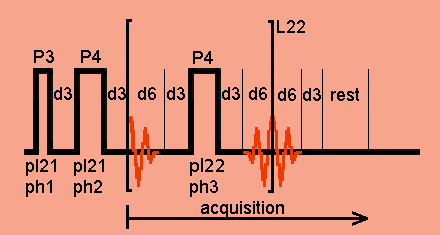
; qcpmg (TopSpin 2.0)
; AVANCE III
; FAU, 09/05/2007
; written by Stefan Steuernagel
; use rotor-synchronized CPMG train of refocusing pulses to create the echoes

; pulse program for quadrupolar CPMG sequence
; samples continuously, including ALL pulses and ringdown delays
; may be used with digmod digital
; important: only runs via SGU in channel 1

;parameters:
;ns : 16 * n
;d1 : recycle delay
;d3 : time to allow pulse ringdown, 10 to 100 us
;d6 : enter duration of FID
;pl1 : =120 dB, not used
;pl21 : RF power level
;pl22 : =pl21 usually, =120 dB if 180° pulses are not desired
;p3 : 90 degree pulse
;p4 : 180 degree pulse
;p25 : dummy pulse, used for showing cnst1 in ased
;l22 : # of echos to be acquired
;cnst1 : set td to number of acquired complex data points

;$COMMENT=quadrupolar CPMG sequence, samples continuously, pulses blanked out, requires DRU
;$CLASS=Solids
;$DIM=1D
;$TYPE=half integer quadrupoles
;$SUBTYPE=simple 1D
;$OWNER=fabien

#include <Avancesolids.incl>

; "p4=p3*2"
  "cnst1=((d6*2+d3*2+p4)*l22+d6+d3)/dw"
  "p25=cnst1"

define delay rest
  "rest=aq-(cnst1*dw)"

;cnst11 : to adjust t=0 for acquisition, if digmod = baseopt
"acqt0=1u*cnst11"

1 ze                   ;clear data
2 d1                   ;relaxation delay
  STARTADC
  RESETPHASE
  (p3 pl21 ph1):f1
  d3
  (p4 ph2):f1
  d3 DWL_CLK_ON        ;start acquisition

3 d6 RG_ON
  0.1u RG_OFF
  d3
  (p4 pl22 ph3):f1
  d3
  d6 RG_ON
  lo to 3 times l22    ;next echo

  d6
  d3
  rest RG_OFF
  0.1u DWL_CLK_OFF     ;stop acquisition
  rcyc=2               ;next scan
  10m wr #0            ;save data
exit

;two coherence transfert pathways are selected:
;0Q -> (+1Q, -1Q) -> (-1Q, +1Q) -> ... -> -1Q
ph0=0
ph1=0 2
ph2=1 1 3 3
ph3=1 1 1 1 3 3 3 3
ph30=0
ph31=2 0

;one coherence transfert pathway is selected depending
;on the number L22 of observed echos:
;either 0Q -> +1Q -> -1Q -> ... -> -1Q     if L22 is even
;or     0Q -> -1Q -> +1Q -> ... -> -1Q     if L22 is odd
;ph0=0
;ph1=0 1 2 3
;ph2=1 0 1 0 3 2 3 2 1 0 1 0 3 2 3 2
;ph3=1 0 1 0 3 2 3 2 3 2 3 2 1 0 1 0
;ph30=0
;ph31=2 3 0 1
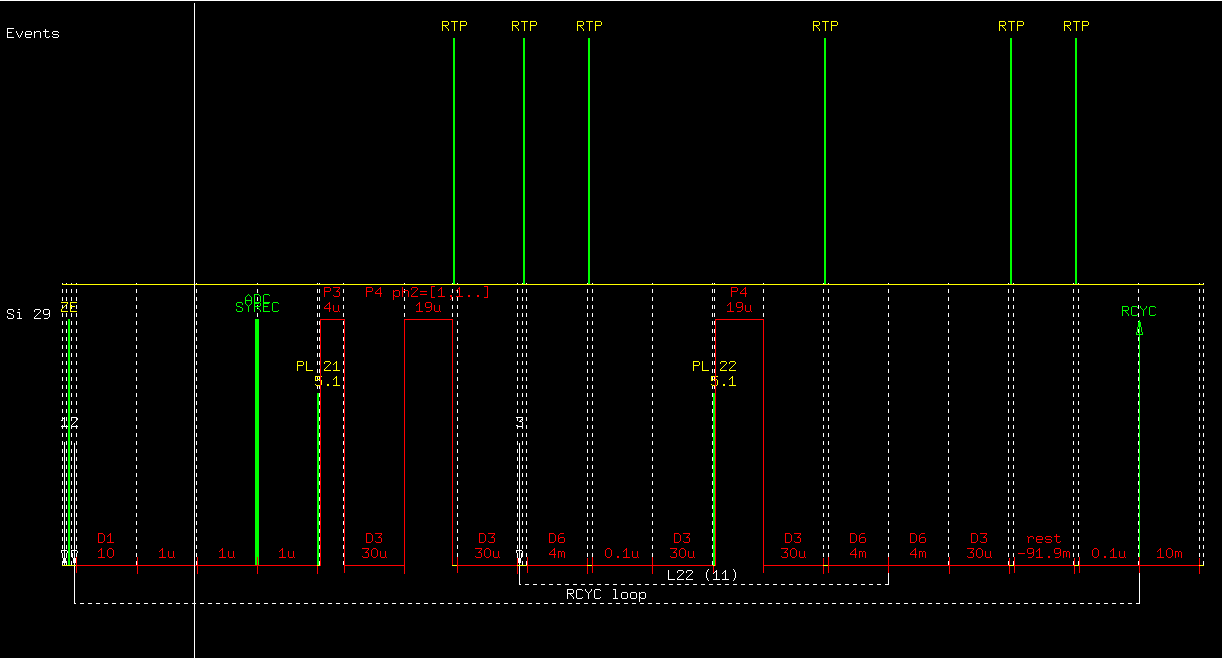
Graphic representation associated with the TopSpin2.1 qcpmg.fau pulse program.
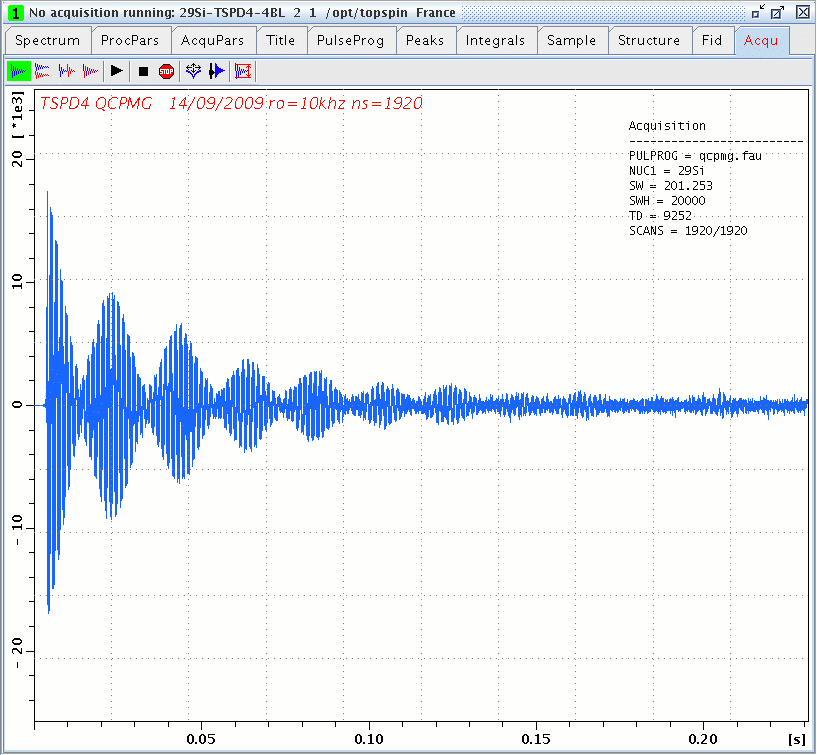
29Si echo train of TSP-d4 in 4 mm diameter rotor spinning at 10 kHz.
Acquisition parameters:
| General | |
| PULPROG | qcpmg.fau |
| TD | 9252 |
| NS | 1920 |
| DS | 0 |
| SWH [Hz] | 20000.00 |
| AQ [s] | 0.2313500 |
| RG | 114 |
| DW [µs] | 25.000 |
| DE [µs] | 6.50 |
| const1 | 9251.456055 |
| CONST11 | 0.0000000 |
| D1 [s] | 30.00000000 |
| D3 [s] | 0.00005000 |
| D6 [s] | 0.01000000 |
| L22 | 11 |
| P25 [µs] | 0.00 |
| rest [s] | 0.00006360 |
| Channel f1 | |
| NUC1 | 29Si |
| P3 [µs] | 3.00 |
| P4 [µs] | 12.40 |
| PL1 [dB] | 120 |
| PL1W [W] | 0.00000000 |
| PL21 [dB] | 6.00 |
| PL21W [W] | 130.4819793 |
| PL22 [dB] | 6.00 |
| PL22W [W] | 130.4819793 |
| SFO1 [MHz] | 99.3774009 |
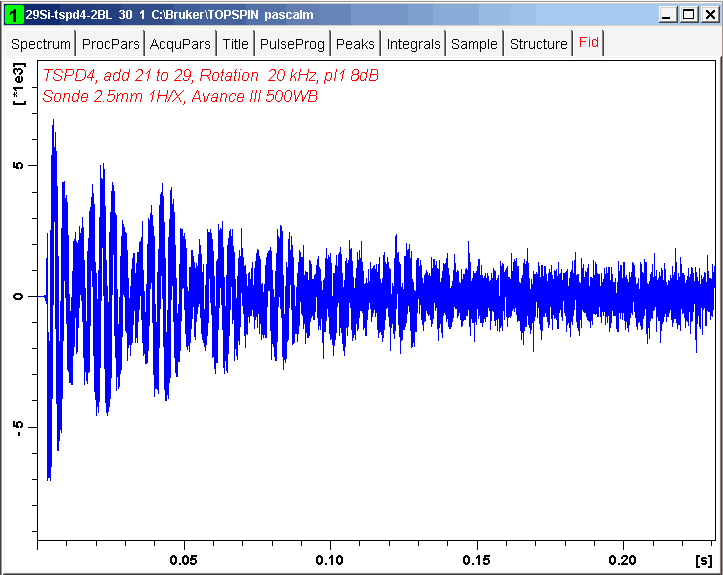
29Si echo train of TSP-d4 in 2.5 mm diameter rotor spinning at 20 kHz.
Acquisition parameters:
| General | |
| PULPROG | qcpmg.fau |
| TD | 9252 |
| NS | 360 |
| DS | 0 |
| SWH [Hz] | 20000.00 |
| AQ [s] | 0.2313500 |
| RG | 512 |
| DW [µs] | 25.000 |
| DE [µs] | 6.50 |
| const1 | 9250.399414 |
| CONST11 | 0.0000000 |
| D1 [s] | 180.0000000 |
| D3 [s] | 0.00005000 |
| D6 [s] | 0.01000000 |
| L22 | 11 |
| P25 [µs] | 0.00 |
| rest [s] | 0.00009002 |
| Channel f1 | |
| NUC1 | 29Si |
| P3 [µs] | 5.00 |
| P4 [µs] | 10.00 |
| PL1 [dB] | 120 |
| PL1W [W] | 0.00000000 |
| PL21 [dB] | 8.00 |
| PL21W [W] | 82.32855988 |
| PL22 [dB] | 8.00 |
| PL22W [W] | 82.32855988 |
| SFO1 [MHz] | 99.3782330 |