
Knowing the quadrupole coupling in NMR (nuclear magnetic resonance) of a nucleus in solids allows us to determine the local symmetry of a crystallographic site.
With a featureless NMR lineshape, lineshape analysis is not suitable for determining the quadrupole coupling. Since the variation of the line intensity versus the RF (radio-frequency) pulse length depends on the quadrupole coupling, the one-dimensional nutation method, which records a series of spectra for increasing RF pulse length, allows us to extract the quadrupole coupling by fitting the experimental line intensities to the theoretical curve.
Java applets are provided for calculating the nutation NMR line intensity of half-integer quadrupole spins, excited by various RF pulse sequences, in order to determine the quadrupole coupling in a single crystal and powder by fitting a series of experimental line intensities with the Simplex procedure.
The JDK1.1.8 applets are launched with Java Web Start, which is included in the Java Runtime Environment (JRE) since release of Java 5.0. This means that when you install Java, you get Java Web Start installed automatically.
Recent NMR books, encyclopedia, reviews, and theses
 Modern NMR Crystallography:
Concepts and Applications
Modern NMR Crystallography:
Concepts and ApplicationsDavid L. Bryce (Ed.)
Royal Society of Chemistry (2025).
 Experimental Approaches of NMR Spectroscopy II,
Application to Life Science and Materials Science
Experimental Approaches of NMR Spectroscopy II,
Application to Life Science and Materials ScienceThe Nuclear Magnetic Resonance Society of Japan (Ed.)
Springer, second edition (2025).
Quadrupole Effects in Solid-state NMR,
Basic principles and experimental techniques for nuclei with half-integer spins (2013-2024),
Dieter Freude and Jürgen Haase.
PDF
 Spin, From Basic Symmetries to Quantum Optimal Control
Ilya Kuprov
Springer (2023).
Advanced solid-state NMR spectroscopy and its applications in zeolite chemistry,
Mingji Zheng, Yueying Chu, Qiang Wang, Yongxiang Wang, Jun Xu, and Feng Deng
Prog. Nucl. Magn. Reson. Spectrosc. 140-141, 1-41 (2024).
Open access
Review for advanced NMR characterization of
carbon-based and metal anodes in sodium batteries,
Yongqi Chen, Zhe Dong, Shen Lai, Yubin Li, Wei Lv, Yan-Bing He, Feiyu Kang, and Ming Liu
Adv. Funct. Mater., 2408657/1-2408657/22 (2024).
Abstract
_NMR_Methods.jpg) Two-Dimensional (2D) NMR Methods (English Edition) Format Kindle,
Two-Dimensional (2D) NMR Methods (English Edition) Format Kindle,K. Ivanov, P. K. Madhu, and G. Rajalakshmi (Eds.)
Wiley (2023).
 Special Issue: Geoffrey Bodenhausen Festschrift,
Daniel Abergel, Fabien Ferrage, and Konstantin Ivanov (Eds.)
Groupement AMPERE (2023).
Recent progress in solid-state NMR of spin-½ low-γ nuclei applied to inorganic materials,
Mark E. Smith
Phys. Chem. Chem. Phys. 25, 26-47 (2023).
Open access
Probing oxide-based glass structures by solid-state NMR: Opportunities and limitations,
Mattias Edén
J. Magn. Reson. Open 16-17, 100112/1-100112/57 (2023).
Open access
Solid-state NMR studies of lithium ion dynamics across materials classes: Review update,
C. Vinod Chandran and Paul Heitjans
Annu. Rep. Nucl. Magn. Reson. Spectrosc. 106, 1-51 (2022).
Abstract
Solid-state NMR spectroscopy,
Bernd Reif, Sharon E. Ashbrook, Lyndon Emsley, and Mei Hong
Nat. Rev. Methods Primers 1, 2 (2021).
Abstract,
[HTML] nih.gov
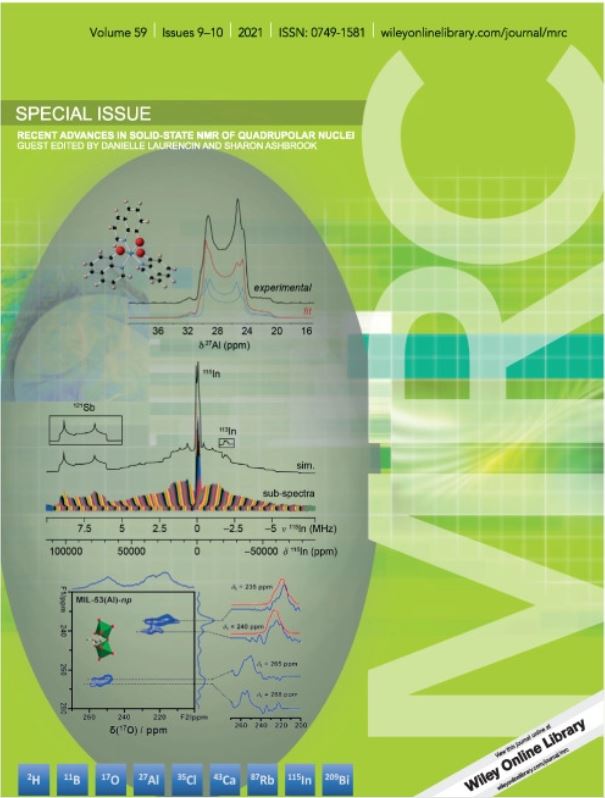 Special Issue: Recent advances in solid‐state NMR of quadrupolar nuclei,
Danielle Laurencin and Sharon Ashbrook (Eds.)
Wiley (2021).
Swelling layered minerals applications: A solid state NMR overview,
Esperanza Pavón and María D. Alba
Prog. Nucl. Magn. Reson. Spectrosc. 124-125, 99-128 (2021).
Open access
Single-crystal NMR spectroscopy,
Thomas Vosegaard
Prog. Nucl. Magn. Reson. Spectrosc. 123, 51-72 (2021).
Open access
 Solid State NMR: Principles, Methods and Applications,
Klaus Müller and Marco Geppi
Wiley-VCH GmbH (2021).
Versatile NMR simulations using SIMPSON,
Dennis W. Juhl, Zdeněk Tošner, and Thomas Vosegaard
Annu. Rep. Nucl. Magn. Reson. Spectrosc. 100, 1-59 (2020).
Abstract
 Handbook of High Field Dynamic Nuclear Polarization (eMagRes Books),
Vladimir K. Michaelis, Robert G. Griffin, Björn Corzilius, and Shimon Vega (Eds.)
Wiley (2020).
Solid state NMR: A powerful tool for the characterization of borophosphate glasses,
Grégory Tricot, Lazzat Alpysbay, and Bertrand Doumert
Molecules 25, 428/1-428/15 (2020).
Open access
Solid-state NMR techniques for the structural
characterization of cyclic aggregates based on
borane–phosphane frustrated Lewis pairs,
Robert Knitsch, Melanie Brinkkötter, Thomas Wiegand, Gerald Kehr, Gerhard Erker,
Michael Ryan Hansen, and Hellmut Eckert
Molecules 25, 1400/1-1400/39 (2020).
Open access
 Solid-State NMR in Zeolite Catalysis,
Jun Xu, Qiang Wang, Shenhui Li, and Feng Deng
Springer (2019).
Alumina: discriminative analysis using 3D correlation of solid-state NMR parameters,
C. Vinod Chandran, Christine E. A. Kirschhock, Sambhu Radhakrishnan,
Francis Taulelle, Johan A. Martens, and Eric Breynaert
Chem. Soc. Rev. 48, 134-156 (2019).
Abstract
Perspectives on high-field and solid-state NMR methods of quadrupole nuclei,
Zhehong Gan
J. Magn. Reson. 306, 86-90 (2019).
Full text access
Paramagnetic NMR in solution and the solid state,
Andrew J. Pell, Guido Pintacuda, and Clare P. Grey
Prog. Nucl. Magn. Reson. Spectrosc. 111, 1-127 (2019).
Open Access Article
 Modern Methods in Solid-state NMR:
A Practitioner’s GuideCheck Access
Modern Methods in Solid-state NMR:
A Practitioner’s GuideCheck AccessPaul Hodgkinson (Ed.)
Royal Society of Chemistry (2018).
 Special Issue: Software tools and tutorials in liquid state NMR,
Damien Jeannerat (Ed.)
Wiley (2018).
Perspective: Current advances in solid-state NMR spectroscopy,
Sharon E. Ashbrook and Paul Hodgkinson
J. Chem. Phys. 149, 040901-040901/14 (2018).
Abstract
 Modern Magnetic Resonance, 2nd Edition,
Graham A. Webb (Ed.)
Springer (2018).
Revised and updated second edition with recent studies post 2008
 Modern Methods in Solid-state NMR: A Practitioner’s Guide,
Paul Hodgkinson (Ed.)
The Royal Society of Chemistry (2018).
 Irreducible Cartesian Tensors,
Robert F. Snider
Walter de Gruyter, Berlin (2018).
Atomic-scale structure of gel materials by solid-state NMR,
Mark E. Smith and Diane Holland
in Handbook of Sol-Gel Science and Technology, Processing, Characterization and
Applications, Second Edition
L. Klein, M. Aparicio, and A. Jitianu (Eds),
Springer, Cham, pages 1281-1322 (2018).
Abstract
Synthesis of non-siliceous glasses and their structural characterization by solid-state NMR,
Hellmut Eckert
in Handbook of Sol-Gel Science and Technology, Processing, Characterization and
Applications, Second Edition
L. Klein, M. Aparicio, and A. Jitianu (Eds),
Springer, Cham, pages 1323-1373 (2018).
Abstract
 Experimental Approaches of NMR Spectroscopy,
Methodology and Application to Life Science and Materials Science
Experimental Approaches of NMR Spectroscopy,
Methodology and Application to Life Science and Materials ScienceThe Nuclear Magnetic Resonance Society of Japan (Ed.)
Springer, Singapore (2018).
 Encyclopedia of Spectroscopy and Spectrometry, 3rd Edition,
John C. Lindon, George E. Tranter, and David W. Koppenaal (Eds.)
Academic, Amsterdam (2017).
Understanding surface and interfacial chemistry
in functional nanomaterials via solid-state NMR,
Alessandro Marchetti, Juner Chen, Zhenfeng Pang, Shenhui Li, Daishun Ling, Feng Deng, and Xueqian Kong
Adv. Mater. 29, 1605895 (2017).
Abstract
Dynamic nuclear polarization for sensitivity enhancement in modern solid-state NMR,
Aany Sofia Lilly Thankamony, Johannes J. Wittmann, Monu Kaushik, and Björn Corzilius
Prog. Nucl. Magn. Reson. Spectrosc. 102-103, 120-195 (2017).
Open Access Article
Basics of solid-state NMR for application in zeolite science:
Material and reaction characterization,
A. G. Stepanov
in Zeolites and Zeolite-like Materials,
Bert F. Sels and Leonid M. Kustov (Eds),
Elsevier, Amsterdam, pages 137-188 (2016).
Abstract
Recent advances in application of 27Al NMR spectroscopy to materials science,
Mohamed Haouas, Francis Taulelle, and Charlotte Martineau
Prog. Nucl. Magn. Reson. Spectrosc. 94-95, 11-36 (2016).
Abstract
Wigner active and passive rotation matrices applied to NMR tensor,
Pascal P. Man
Concepts Magn. Reson. 45A, 1-64 (2016).
Free to read
Analytic theory of multiple-quantum NMR of quadrupolar nuclei,
G. Vinay and R. Ramachandran
Annu. Rep. Nucl. Magn. Reson. Spectrosc. 89, 123-184 (2016).
Abstract
Solid-state NMR studies of lithium ion dynamics across materials classes,
C. Vinod Chandran and Paul Heitjans
Annu. Rep. Nucl. Magn. Reson. Spectrosc. 89, 1-102 (2016).
Abstract
Reviewing 47/49Ti solid-state NMR spectroscopy: from alloys and
simple compounds to catalysts and porous materials,
Bryan E. G. Lucier and Yining Huang
Annu. Rep. Nucl. Magn. Reson. Spectrosc. 88, 1-78 (2016).
Abstract
Advances in 27Al MAS NMR studies of geopolymers,
Jiri Brus, Sabina Abbrent, Libor Kobera, Martina Urbanova, and Pavel Cuba
Annu. Rep. Nucl. Magn. Reson. Spectrosc. 88, 79-147 (2016).
Abstract
The use of 27Al NMR to study aluminum compounds: a survey of the last 25 years,
Charlotte Martineau, Francis Taulelle, and Mohamed Haouas
PATAI’s Chemistry of Functional Groups, John Wiley & Sons (2016).
Recent advances in 14N solid-state NMR,
Eddy Dib, Tzonka Mineva, and Bruno Alonso
Annu. Rep. Nucl. Magn. Reson. Spectrosc. 87, 175-235 (2016).
Abstract
Microporous mesoporous solid bibliography
Solid-state NMR bibliography for
- Aluminum-27 (鋁)
- Antimony-121/123 (銻)
- Arsenic-75 (砷)
- Barium-135/137 (鋇)
- Beryllium-9 (鈹)
- Bismuth-209 (鉍)
- Boron-10/11 (硼)
- Bromine-79/81 (溴)
- Calcium-43 (鈣)
- Cesium-133 (銫)
- Chlorine-35/37 (氯)
- Chromium-53 (鉻)
- Cobalt-59 (鈷)
- Copper-63/65 (銅)
- Deuterium-2 (氘)
- Gallium-69/71 (鎵)
- Germanium-73 (鍺)
- Gold-197 (金)
- Hafnium-177/179 (鉿)
- Indium-113-115 (銦)
- Iodine-127 (碘)
- Iridium-191/193 (銥)
- Krypton-83 (氪)
- Lanthanum-139 (鑭)
- Lithium-6/7 (鋰)
- Magnesium-25 (鎂)
- Manganese-55 (錳)
- Mercury-201 (銾)
- Molybdenum-95/97 (鉬)
- Neon-21 (氖)
- Nickel-61 (鎳)
- Niobium-93 (鈮)
- Nitrogen-14 (氮)
- Osmium-189 (鋨)
- Oxygen-17 (氧)
- Palladium-105 (鈀)
- Potassium-39/41 (鉀)
- Rhenium-185/187 (錸)
- Rubidium-85/87 (銣)
- Ruthenium-99/101 (釕)
- Scandium-45 (鈧)
- Sodium-23 (鈉)
- Strontium-87 (鍶)
- Sulfur-33 (硫)
- Tantalum-181 (鉭)
- Titanium-47/49 (鈦)
- Vanadium-51 (釩)
- Xenon-131 (氥)
- Zinc-67 (鋅)
- Zirconium-91 (鋯)
Microporous mesoporous solid bibliography
 Springer Handbook of Advanced Catalyst Characterization,
Israel E. Wachs and Miguel A. Bañares (Eds.),
Springer Cham (2023).
 Magnetic Properties of Non-Metallic Inorganic Compounds Based on Transition Elements,
Tectosilicates, Part δ
Magnetic Properties of Non-Metallic Inorganic Compounds Based on Transition Elements,
Tectosilicates, Part δE. Burzo,
Springer-Verlag, Berlin (2017).
 Zeolites and Zeolite-like Materials,
Bert F. Sels and Leonid M. Kustov (Eds.),
Elsevier, Amsterdam (2016).
 Springer Handbook of Nanomaterials,
Robert Vajtai (Ed.),
Springer-Verlag, Berlin (2013).
 Characterization of Solid Materials and Heterogeneous Catalysts,
From Structure to Surface Reactivity
Characterization of Solid Materials and Heterogeneous Catalysts,
From Structure to Surface ReactivityMichel Che and Jacques C. Vedrine (Eds.),
Wiley-VCH, Weinheim (2012).
 Zeolites and ordered porous solids: fundamentals and applications,
Cristina Martínez and Joaquín Pérez-Pariente (Eds.),
Editorial Universitat Politècnica de València, Madrid/Valencia, (2011).
Solid-state nuclear magnetic resonance investigations of the nature,
property, and activity of acid sites on solid catalysts,
Yijiao Jiang, Jun Huang, Weili Dai, and Michael Hunger
Solid State Nucl. Magn. Reson. 39, 116-141 (2011).
Abstract
 Characterization and Design of Zeolite Catalysts,
Miki Niwa, Naonobu Katada, and Kazu Okumura,
Springer-Verlag, Berlin (2010).
Google book
 Metal Oxide Catalysis,
S. David Jackson and Justin S. J. Hargreaves (Eds.),
Wiley-VCH Verlag, Weiheim (2009).
Google book