AIM: Determination of the quadrupole coupling from a featureless NMR lineshape
Launch the rotary-echo pulse applet with Java Web Start.
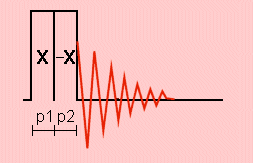
Despite the name of this sequence, we do not perform echo experiments because the signal is observed at the end of the second pulse.
Two rotary-echo sequences are presented:
X-(-X): {+X,-X}-acq(y)
Even-X: {+X,-X}-acq(y)
Even-X: {-X,-X}-acq(y)
These sequences do not cancel spurious signals whereas the composite-pulse sequence does. On the other hand, if the two pulse-lengths are identical (p1 = p2), the X-(-X) sequence cancels signals with small and strong quadrupolar couplings.
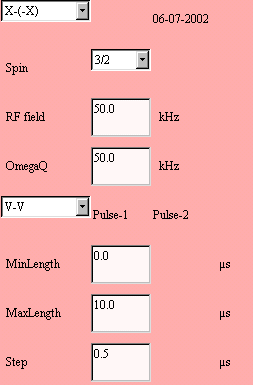
The left part of the panel indicates the parameters of the simulation. It is preset for a typical experiment on a spin I = 3/2. You can introduce your own values.
First, we select one of the two rotary-echo sequences with the upper choice box.
Then, we select one of the three types of line intensity
calculation with the lower choice box:
(1) V-V: when p1 = p2 and varying simultaneously;
(2) V-F: when p1 is variable and p2 is constant;
(3) F-V: when p1 is constant and p2 is variable.
When p1 = p2, only the parameters for p1 are required.
When a pulse length is constant, it should be provided in the MinLength field.
MinLength: the first variable pulse-length in µs
MaxLength: the last variable pulse-length in µs
Step: the increment of the variable pulse-length in µs
The following applet is initialized for the central-line intensity of a spin I = 3/2 in a single crystal excited by the X-(-X) rotary-echo sequence where the two pulse-lengths vary identically. The experimental line intensities are identical to the simulated ones.
Help for selecting all the simulated data of the line intensity text area in a JDK1.1.8 applet.