-3QMAS two-pulse program for I = 3/2 and Bruker ASX spectrometer
-3QMAS two-pulse program for I = 3/2 and Bruker ASX spectrometer
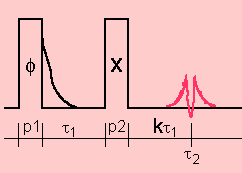
This is a pulse program for two-dimensional -3Q-MAS experiment for quadrupolar nuclei with I = 3/2. The echo position is tau2 = (7/9)*tau1.
This hypercomplex acquisition pulse program is provided by D. Massiot. The data processing could be performed with the RMN(fat) program for Macintosh provided by P. J. Grandinetti according to the relationships:
We choose the same processing procedure for all the quadrupolar nuclei with half-inter spin I in 3QMAS experiments. As a result, the phase list ph2 for the first pulse in the pulse program differs with that for I > 3/2.
      ze                   ; clear memory, new data replace old data
                           ; switch AD converter to replace mode
                           ; perform DS before next acquisition
    ; acquire first half
    2 rp1                  ; reset phase ph1 of the first pulse
      rp2                  ; reset phase ph2 of the first pulse
      rp3                  ; reset phase ph3 of the second pulse
      rp31                 ; reset the receiver phase ph31
    3 d1:c4 ph1 tlo        ; recycle delay, high power
      p1:c4 ph1            ; the first-pulse duration p1
      d6:c4                ; delay between pulses, t1 increment
      p2:c4 ph3            ; the second-pulse duration p2
      2u:c4
      go=3 ph31            ; signal acquisition,
                           ; loop to 3, NS times for averaging
      d11 wr #0 if #0 zd   ; delay for disk I/O, store signal,
                           ; increase FID number
                           ; delete memory data
                           ; do not perform dummy scans
                           ; with next acquisition
    ; acquire second half
      rp1                  ; reset phase ph1 of the first pulse
      rp2                  ; reset phase ph2 of the first pulse
      rp3                  ; reset phase ph3 of the second pulse
      rp31                 ; reset the receiver phase ph31
   10 d1:c4 ph2 tlo        ; recycle delay, high power
      p1:c4 ph2            ; the first-pulse duration p1
      d6:c4                ; delay between pulses, t1 increment
      p2:c4 ph3            ; the second-pulse duration p2
      2u:c4
      go=10 ph31           ; signal acquisition,
                           ; loop to 10, NS times for averaging
      d11 wr #0 if #0 zd
      id6                  ; increment time d6 by in6
      lo to 2 times L1     ; next experiment,
                           ; loop to 2, L1 times
    exit                   ; end of the pulse program

    ph1=(12) {0  2  4  6  8 10}^3^6^9     ; p1 pulse phase
    ph2=(12) {11 1  3  5  7  9}^3^6^9     ; p1 pulse phase
    ph3=     {0  0  0  0  0  0}^1^2^3     ; p2 pulse phase
    ph31=    {0  2  0  2  0  2}^1^2^3     ; receiver phase